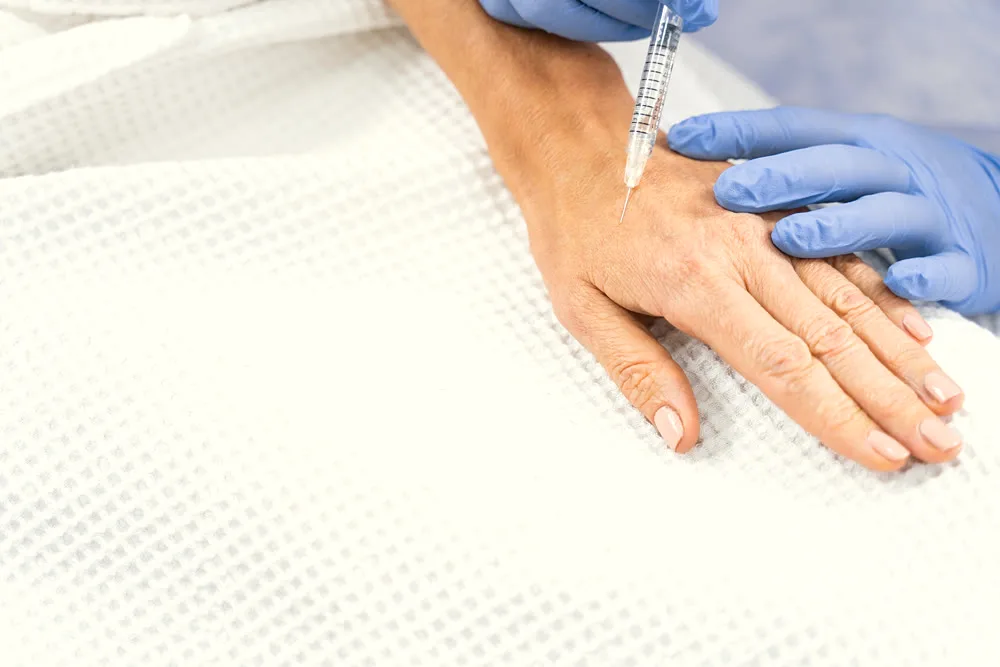
How long does Sculptra last, and what affects it
By the Estetika Med Spa · · 4 min read
For most people, Sculptra results last between two and three years. That range is longer than most injectable fillers, but it depends on the number of sessions completed, how the body processes collagen, and individual skin characteristics. Results build gradually over several months rather than appearing right after the appointment.
If you are researching how long Sculptra lasts before booking an appointment, you are already asking the right question. Most people want to know whether the investment makes sense over time, and the honest answer is that Sculptra tends to last longer than most injectables: two to three years for the majority of patients, sometimes more. But that number does not come from a single injection, and it does not look the same for everyone.
How Sculptra works, and why timing matters
Sculptra is a poly-L-lactic acid biostimulator. That means it does not add volume directly the way a traditional filler does. Instead, it stimulates the skin to produce its own collagen over the months following treatment. The U.S. Food and Drug Administration has cleared Sculptra for the correction of shallow to deep facial wrinkles and folds, and for use in HIV-related facial lipoatrophy.
Because the results come from new collagen rather than from an injected substance, they take time to appear. The product itself is absorbed by the body over the first few weeks, and then the collagen-building process continues. Most of the visible change shows up two to six months after completing the treatment plan.
At Estetika, we think of Sculptra as a long-term investment in the skin’s own structure, not a quick fix.
What actually determines how long it lasts
Several factors shape how long Sculptra results hold for any individual patient:
- Number of sessions completed. A full treatment plan, usually more than one session spaced several weeks apart, tends to produce more durable results than a single appointment.
- Age and baseline collagen levels. The body’s ability to generate collagen slows with age. Patients in their forties or fifties may need more sessions to reach the same degree of improvement as someone younger.
- Lifestyle factors. Sun exposure, smoking, and significant weight changes can all affect how long collagen holds up. Consistent sun protection tends to help results last.
- Metabolism. Some people process injectables faster than others. This is not something that can be predicted with precision before treatment.
- Area treated. Areas with more movement, like around the mouth, can see results fade sooner than areas with less activity.
How it compares to other injectables
Sculptra is not the right choice for every concern, and comparing it honestly to other options helps set realistic expectations.
| Sculptra | Hyaluronic acid filler | Botox / Dysport | |
|---|---|---|---|
| Primary action | Collagen stimulation | Direct volume replacement | Muscle relaxation |
| Onset | 2 to 6 months | Immediate | 3 to 7 days |
| Duration (most patients) | 2 years or more | 6 to 18 months | 3 to 4 months |
| Best for | Gradual volume loss, skin texture | Specific hollows, lip volume | Dynamic lines |
Patients who want an immediate result before an event are usually better served by a different treatment. Sculptra rewards those who are willing to wait.
What to expect during and after sessions
The injections are done in the office and take less than an hour in most cases. A topical numbing agent is applied beforehand, and the injector will massage the area after treatment. That massage step is part of the protocol: it helps distribute the product evenly and reduces the chance of small nodules forming under the skin.
In the days after the appointment, swelling, redness, and some bruising are common. These effects resolve on their own for most patients. There is no period where normal activity needs to stop, though the injector may recommend avoiding intense sun exposure and certain activities for a short window.
Some patients notice that the treated area looks better immediately after the session, then seems to return to baseline as the swelling goes down. This is normal. The real results come later, as collagen builds.
Maintaining results over time
Because Sculptra stimulates the body’s own tissue rather than sitting as a foreign substance, touch-up sessions tend to be less frequent than with traditional fillers. Many patients return for a maintenance session after two years or so, depending on how their results have evolved. That timeline is not fixed, and the injector will assess what makes sense at follow-up appointments.
Exploring our full injectable treatments page gives a broader view of how Sculptra fits alongside other options like Radiesse, Botox, and Dysport.
Who Sculptra is not the right fit for
Sculptra is a collagen stimulator, not a volumizing filler in the traditional sense. It does not work well for very specific or precise volume needs, like adding definition to a particular hollow in one session. It is also not appropriate during pregnancy or for patients with certain autoimmune conditions. The product should be used with caution in patients who have had prior treatments with permanent fillers in the same area, because the interaction can be unpredictable.
Patients who want immediate, visible results will likely find the waiting period frustrating. And for concerns that respond better to muscle relaxation, like forehead lines or crow’s feet, Sculptra is simply not the right tool. The evaluation visit is where these distinctions get sorted out.
The role of an experienced injector
Technique matters with Sculptra. The product needs to be mixed and injected in a way that minimizes the risk of nodule formation, and the depth and placement of the injection affects how the collagen develops. The injector’s familiarity with facial anatomy and with this specific product makes a material difference in the outcome.
You can review what to expect during a visit on the /faq/ page, or check membership options if you are considering ongoing treatments.
If you are weighing whether Sculptra makes sense for your goals, the clearest next step is a face-to-face evaluation. Book your consultation at Estetika and we will go through your concerns, your timeline, and the options that fit both.
Frequently asked questions
How is Sculptra different from regular filler in terms of longevity?
Traditional hyaluronic acid fillers typically last six to eighteen months before the body absorbs them. Sculptra works differently: it stimulates the body's own collagen production over time, and for most people the results hold for two years or more. The trade-off is that Sculptra takes several months to show its full effect, while filler is visible almost immediately.
How many Sculptra sessions do I need?
Most treatment plans involve more than one session, spaced several weeks apart. The exact number depends on the degree of volume loss and the areas being treated, and that decision is made during a one-on-one evaluation. Trying to get everything done in one appointment is not how Sculptra is designed to work.
When will I actually see results?
Sculptra works by triggering collagen production, so the changes appear gradually. Many patients start to notice a difference after the first few weeks, but the most visible improvement tends to come two to six months after completing the treatment plan. Patience is part of the process.
Can Sculptra be combined with other injectables?
Yes, it is common to use Sculptra alongside other treatments. Some patients combine it with Botox or Dysport for dynamic lines, or with a different filler for precise volume in a specific area. Whether that combination makes sense for a particular patient is something the injector reviews in consultation.
Does Sculptra hurt, and is there downtime?
Most patients describe the injections as manageable, and a topical numbing agent is usually applied beforehand. There can be swelling, redness, or bruising in the days after the appointment, but these effects typically resolve on their own. There is no significant downtime for most people.
Sources
- U.S. Food and Drug Administration
- American Academy of Dermatology
- American Society of Plastic Surgeons
Educational content. It does not replace a medical consultation at Estetika Med Spa.
Keep reading
Where to have it done in South Florida
Estetika is at 400 E Hallandale Beach Blvd, Hallandale Beach, Florida, 8 minutes from Aventura. Many patients also drive in from Hollywood, 11 minutes away. Consultations are in English or Spanish.